Showing posts with label Mini Muringatheri. Show all posts

Fungus threat to endangered Western Ghats tree


THRISSUR, The Hindu

Scientists have sounded the alarm on a newly detected fungal disease attacking Dipterocarpus bourdillonii, a critically endangered tree endemic to the Western Ghats.

The phytopathogen, Corynespora cassiicola, a highly aggressive fungus, is known to infect more than 530 plant species.

The findings of Shambhu Kumar, Principal Scientist and Head, Forest Pathology Department, Kerala Forest Research Institute, Peechi, along with Raghvendra Singh, Senior Assistant Professor, Department of Botany, Banaras Hindu University, have been published in the June 17th edition of Mycosphere journal.

Serious concerns

This marks the first recorded instance of the pathogen affecting D. bourdillonii, raising serious conservation concerns. The fungus was identified based on morpho-cultural characteristics and molecular phylogenetic evidence.

Detection of the emerging leaf spot and blight disease highlights the urgent need for disease surveillance and integrated conservation strategies to protect one of Western Ghats’ most vulnerable rainforest trees. “Dipterocarpus bourdillonii (family: Dipterocarpaceae) is a critically endangered tree species listed on the IUCN Red List. Endemic to the Western Ghats of India, it plays a vital ecological role in maintaining rainforest canopy structure and supporting biodiversity.

Economically, its hardwood is valued for construction and furniture, while its oleoresin (wood oil) has traditional medicinal and industrial uses. The emergence of this additional biotic threat underscores the urgent need for conservation measures,” Mr. Kumar said. The investigation using morpho-molecular tools is of significant importance.

Molecular identification ensures accurate pathogen detection, overcoming the limitations of morphology-based methods and facilitating early diagnosis and monitoring.

This study is crucial for understanding the disease’s epidemiology, guiding effective disease management strategies, and safeguarding this threatened species.

Additionally, it contributes to forest health surveillance and supports both ex-situ and in-situ conservation efforts, Mr. Kumar pointed out.

Corynespora cassiicola is a widespread phytopathogen causing leaf spots, target spots, and blight diseases in a wide range of plant species, including economically important crops such as rubber, soybean, tomato, cucumber, cotton, besides medicinal and ornamental plants.

Humid climates

It thrives in warm, humid climates and spreads through conidia (spores produced by fungi) via wind, water, and human activity.

The pathogen impairs photosynthesis, leading to defoliation, reduced yield, and plant death in severe cases.

Management of the pathogen involves the use of resistant cultivars, cultural practices (e.g., proper spacing and removal of infected parts), and fungicides such as mancozeb and azoxystrobin.

Read more »

The Kadar tribe takes charge against alien species


THRISSUR, october 26, 2024

In a first, the Kadar tribe of Vazhachal in Thrissur, has taken on active restoration of natural forests degraded by invasive alien species.

This collaborative effort involving the Local Self-Governments department, Mahatma Gandhi National Rural Employment Guarantee Scheme, Scheduled Tribes Development department, WWF-India, and Kerala Forest Research Institute (KFRI) marks a significant step towards freeing natural forests from degrading exotic species.

Supported by the WWF-India, the KFRI had undertaken the mapping of invasive plants in the Vazhachal and Parambikulam forest divisions and 29 and 31 such species had been recorded in these divisions, says T.V Sajeev, chief scientist, KFRI.

“By involving tribal community members in a participatory mapping process, we identified the most degraded areas for restoration,” he says. The spread of invasive plants has severely limited forage space for wildlife, leading to increased human-wildlife conflicts. Additionally, these invaders have diminished the availability of non-timber forest products, threatening the livelihoods of the indigenous communities.

With technical support from the KFRI, the tribal community has started the removal of invasive species such as Lantana camaraChromolaena odorataMimosa diplotricha, and Mikania micrantha.

Follow up

The work will be followed up by planting of species such as Myristica beddomei, Canarium strictum, Garcinia gummi-gutta, Hydnocarpus pentandrus, Curcuma neilgherrensis, Acacia sinuate, Phyllanthus emblica, Entada rheedii, Desmodium gangeticum, Pseudarthria viscida and Sapindus trifoliate, all of which yield forest products usually collected by the community. Over the years, these plants had been displaced by the aggressive invasion of alien plants.

“This initiative not only supports the environment but also enhances the livelihoods of local tribal communities by increasing labour opportunities through the MGNREGA,” says K. Rijesh, ward member, Athirappilly grama panchayat.

The pilot project is being held at Pothupara, a newly established tribal hamlet under the Vazhachal division after a landslip displaced the people from Anakkayam in 2018. This community received Community Forest Resource (CFR) rights under the Forest Rights Act (FRA) in 2014, along with eight other tribal settlements, creating the first CFR area of its kind in Kerala, covering 400 sq km. The nine tribal gram sabhas have already approved their conservation and management plan, which incorporates this vital restoration work.

Read more »

Wayanad sanctuary yields a new spider

Mini Muringatheri, Thrissur 
The Hindu, 16 February, 2019


A new species of spider has been discovered from the Wayanad Wildlife Sanctuary, a major biodiversity hotspot in the State. The new species, Cocalus lacinia, spotted in the Kurichiad forest range of the sanctuary, is taxonomically related to an Australian species, described by arachnologist Fred Wanless in 1981.
A biodiversity investigation team, based at the Centre for Animal Taxonomy and Ecology (CATE), Christ College, Irinjalakuda, spotted the new species.
The head of the 8-mm-long male spider is brownish yellow and there are black lines along the sides of the hairy head region. Its eyebrows and forehead are white. The oval shaped abdomen is yellow and covered with black and white scales. The head of the 13-mm-long female is brownish and hairy. There is a V-shaped black mark on the upper surface of the head and red lines along the sides.

‘United biosphere’

“The nocturnal spider hides in the crevices of teak plants during day, and hunts at night for small insects. This discovery of a new species of spider from India and the presence of its close relative from Australia supports the theory that millions of years ago the biosphere was united and the present continents were formed by splitting a single big continent named Pangea,” says Sudhikumar A.V., Assistant Professor, Department of Zoology, Christ College, who led the team. Investigations are on with the help of genetic samples from the Australian species and Indian species to get more evidence for the theory of supercontinents. It may give more information on plate tectonics and the evolution of modern spiders, he said.
Sudhin P.P., Nafin K.S., and Sumesh N.V., research scholars of CATE, also took part in the study.

Read more »

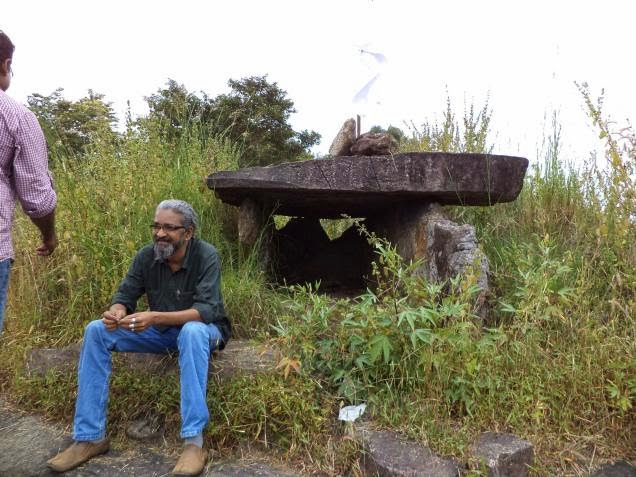
Quarrying destroys megalithic dolmens in Thrissur


Large scale-quarrying has destroyed megalithic dolmens situated in forest area in Muniyattukunnu of Varantharappilly near Thrissur.
“Muniyattukunnu was famous for its dolmens, which were declared as protected monument as per Government proceeding dated 13-10-1937 RDIS 1894-2-1112 development department and in accordance with Cochin Government Ancient Monument Preservation Regulation Act XI of 110,” said Muniyattukunnu Protection Forum, which tries for the protection of the remaining dolmens.
These monuments are mostly in reserved forest of Vellikulanagara range under Chalakudy forest division.
Forest pattayam (title deed) has been used to encroach up on forest land by quarry mafia, alleged the protesters. The forest land assignment pattayam, where only agrarian activities are permitted is widely used for quarrying activities here, noted the forum led by the Kerala Shastra Sahithya Parishath.
As per the document available with Archaeological department only one out of 11 dolmens in the area is remaining now.
A study by the Kerala Shastra Sahithya Parishath shows that Rs. 36 crore has been generated by quarrying from this area.
A team from the district administration led by sub collector carried out a joint inspection on June 21. The team found widespread violations of rules and issued instant stop memos to quarries functioning in Muniyattukunnu, the forum noted. There was also an order for a joint survey by the revenue and forest departments.
However, stop memos were vacated within two weeks by a court order. The joint survey is still pending. Quarry and crusher owners are extending their premises.
The Muniyattukunnu Protection Forum headed by the KSSP has once again approached the district Collector seeking the protection of this valuable historical site.
The forum urged the authorities to issue stop notice to all the quarries running in the area.
“The stone quarrying is now being carried out in the land where pattas are issued as per the Kerala Land Assignment Special Rules 1993. According to Rule 3 the land cannot be used for quarrying purpose. So the authorities should take action to cancel the pattas for the land in which quarries are operational,” it demanded.

Read more »

Marine biodiversity cells mooted for protection of sea turtles

Mini Muringatheri

The Hindu, October 21, 2014 
Experts have suggested the formation of national and State-level marine biodiversity cells for the conservation of sea turtles and marine fauna.
The objective of the biodiversity cell will be to coordinate between participatory departments to improve nesting habitats and check causes of mortality.
The national consultation workshop held at the Kerala Forest Research Institute (KFRI) discussed an action plan for the conservation of endemic turtles in peninsular India and sea turtles. Protection of habitats and the nests of the species and the improvement of their quality are the prime concerns of the action plan.
The removal of Casuarina and sand dune management in identified nesting sites have also proposed.
Enhancing community participation in conservation through NGOs, regional co-operation programmes, training workshops and awareness campaigns were also discussed.
There was lack of awareness about the species, particularly with respect to its distribution, breeding biology and habitat requirements. The workshop recommended the inclusion of the importance of conservation in training curriculum for field staff in State forest training schools and forestry colleges.
Five of the seven species of sea turtles found worldwide are reported to occur in Indian coastal waters. They nest along the Indian coastline. Sea turtles are protected under the Indian Wildlife Protection Act, and the trade in turtle products is also prohibited.
The workshop was organised by the KFRI in collaboration with the Wildlife Institute of India and the Ministry of Environment and Forests.
 

Read more »